The 'Missed Text Message': The Biological Root of Food Noise.
You know the feeling. You ate a full meal ninety minutes ago. You know — intellectually, rationally, with complete certainty — that you are not hungry. And yet the thought of food won't leave. It loops. It intrudes. It sits in the background of your consciousness like a notification you can't dismiss.
The wellness industry calls this a lack of willpower. The diet industry calls it emotional eating. But a growing body of research in cellular biology and neuroendocrinology points to something far more specific — and far more fixable: your satiety signals are being sent, but they're not being received.
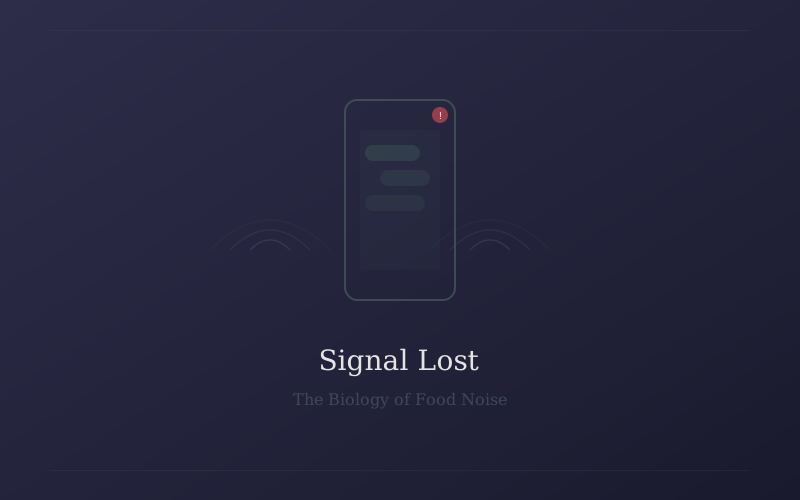
Think of it as a missed text message. The message was composed. It was sent. But somewhere between the sender and the recipient, it never arrived. And so the sender keeps sending, over and over, and the recipient — your brain — never gets the memo that you're full.
The Signaling System You've Never Heard Of
Your body runs on chemical messengers. Hormones, peptides, neurotransmitters — these are the text messages of your biology. When you eat, a cascade of these signals fires in sequence, each one carrying a specific piece of information from your gut to your brain.
The key players in the satiety signaling chain include:
- Leptin — produced by fat cells, it tells the hypothalamus how much energy is stored and whether you need more food
- GLP-1 (glucagon-like peptide-1) — released by cells in the gut after eating, it signals fullness and slows gastric emptying
- PYY (peptide YY) — secreted by the intestines, it reduces appetite and promotes the feeling of having had enough
- CCK (cholecystokinin) — released in response to fat and protein in the upper intestine, it signals short-term satisfaction
- Insulin — beyond its glucose-management role, it also acts as a satiety signal in the brain
In a healthy system, these molecules work in concert. You eat. They fire. Your brain registers satisfaction. You stop thinking about food. The loop closes. End of story.
But what happens when the loop doesn't close?
Receptor Resistance: When the Inbox is Full
The concept of insulin resistance is well known by now — the idea that cells can become desensitized to insulin after prolonged overexposure. But insulin is not the only signal subject to this degradation. Leptin resistance is now recognized as a primary driver of obesity and metabolic dysfunction, and the same receptor-desensitization mechanism affects GLP-1, PYY, and virtually every signaling molecule in the satiety cascade.
Here's the mechanism, simplified: every cell has receptors — molecular locks that specific chemical keys (hormones) fit into. When a receptor receives its matching hormone, it triggers an intracellular response. But when receptors are bombarded with signals continuously — due to chronic overeating, constant snacking, or metabolic inflammation — they begin to downregulate. They literally retract from the cell surface. They become fewer in number and less sensitive to the signals they're designed to receive.
The hormone is still being produced. The "text message" is still being sent. But the receptor — the phone — has been turned off. Or the inbox is full. Or the notification settings have been silenced. Pick your metaphor. The result is the same: the signal never arrives.
Food noise is not a psychological failure. It is a receptor communication failure. Your gut is screaming "we're full" and your brain literally cannot hear it.
The Inflammation Amplifier
If receptor resistance is the immediate cause of food noise, chronic low-grade inflammation is the accelerant. And this is where the science gets uncomfortably relevant to modern life.
Metabolic inflammation — sometimes called metaflammation — is a persistent, low-level inflammatory state driven by factors including excess visceral fat, ultra-processed food consumption, disrupted sleep, chronic stress, and gut microbiome imbalance. Unlike acute inflammation (a cut, an infection), you don't feel metaflammation directly. There's no pain, no swelling, no obvious symptom. But at the cellular level, it wreaks havoc on signaling.
Inflammatory cytokines — molecules like TNF-alpha, IL-6, and C-reactive protein — directly interfere with hormone receptor function. They disrupt the intracellular signaling pathways that leptin, GLP-1, and insulin rely on to transmit their messages. In essence, inflammation creates static on the line. Even if the receptor is still present and the hormone is still circulating, the signal gets garbled.
This creates a vicious cycle: impaired signaling leads to overeating, overeating drives more inflammation, more inflammation further degrades signaling. The loop feeds itself. And at the center of it, the person experiences something they interpret as hunger — but which is actually a communication failure masquerading as appetite.
Why GLP-1 Drugs Work (and What They Reveal)
The explosion of GLP-1 receptor agonist drugs — semaglutide (Ozempic, Wegovy), tirzepatide (Mounjaro) — has inadvertently provided the most compelling evidence for the signaling theory of food noise. Patients on these drugs consistently report the same thing: the noise stopped.
They don't describe reduced cravings in the way a dieter describes white-knuckling past a doughnut. They describe the complete absence of intrusive food thoughts. The loop closes. The signal arrives. The brain registers satisfaction.
What these drugs do, pharmacologically, is bypass the broken receptor system. They deliver a GLP-1 signal that is structurally modified to resist the enzymatic degradation that normally limits natural GLP-1's lifespan. They are, in effect, a text message written in permanent ink — one the body cannot easily ignore, even when the receptors are desensitized.
The clinical results are dramatic. But they also raise an obvious question: if the problem is signaling, can the signaling system be repaired without pharmacological intervention?
Restoring the Signal
The research here is still evolving, but several evidence-backed strategies have demonstrated the ability to improve receptor sensitivity and reduce the inflammatory interference that drives food noise:
Reducing ultra-processed food intake is the single highest-leverage intervention. UPFs drive inflammation through multiple pathways — emulsifiers disrupting gut barrier function, seed oils promoting oxidative stress, refined carbohydrates spiking insulin. Every reduction in UPF consumption creates a measurable improvement in inflammatory markers.
Prioritizing protein and fiber at the beginning of meals triggers stronger CCK and PYY release, giving the satiety cascade a more robust starting signal. The order in which you eat foods within a meal matters more than most people realize.
Sleep optimization is non-negotiable. A single night of poor sleep reduces leptin levels by up to 18% and increases ghrelin (the hunger hormone) by nearly 30%. Chronic sleep disruption is one of the fastest routes to receptor desensitization.
Targeted movement — particularly resistance training and post-meal walking — improves insulin sensitivity and enhances GLP-1 secretion independently of weight loss.
Reducing meal frequency (without extreme fasting) gives receptors time to resensitize between signaling events. Three structured meals with no snacking appears to be the sweet spot for most metabolically compromised individuals.
The Takeaway
Food noise is real. It is biological. And it is not your fault. It is the predictable result of a signaling system that has been overwhelmed, inflamed, and desensitized by the modern metabolic environment. The fact that it can be silenced — either pharmacologically or through strategic lifestyle intervention — proves that it was never about willpower in the first place.
It was always about whether the message got through.
This report is part of The Metabolic Reset's ongoing coverage of cellular signaling and metabolic health. For weekly dispatches on the latest research, subscribe free.
Get the full picture
Join The Metabolic Reset
Free weekly dispatches on the science of metabolism, blood sugar, and cellular signaling. No spam, ever.
Subscribe Free